Monday, July 5, 2010

Ecuador - Quito II

Besides attending to my self-imposed, obligatory "research" that includes tracking down officials to talk to me about heritage tourism, our seven weeks here have included a variety of adventures, from exploring the hilly streets of Quito to braving the adrenaline-pumping bus rides down the narrow, steep, windy roads to the Pacific coast; to escaping to a small mountain town nestled in a cloud forest. And next week we’re off to the Galapagos ... which will be accompanied by an entourage from the states, including my parents, my brother and his girlfriend, and Vanessa’s dad. Should be exciting, to say the least!

Click on the photo below if you’d like to see some photos from Ecuador.

Ecuador (1)

And if you have a minute (or 20), you can also read my rambling below.

Cheers,

George

###

Quito, July 3, 2010

The regular dissonance of daily life in Quito was replaced by a moment of awkward silence the afternoon Uruguay cheated its way past Ghana into the World Cup semifinals. Perhaps this moment was shared throughout the world, but here it was an especially awkward one because everyone wanted a South American team to prevail, but no one seemed entirely comfortable with celebrating the result.

As the cacophony of motion quickly resumed, I sat down at a café to collect my thoughts after attending a week-long conference, a colloquium on cultural heritage. Flipping through my notes, I was distracted by the monotone shout of a lady whose voice rose above the rest of the noise. Dressed in a traditional indigenous outfit that included a long embroidered skirt, a colorful shawl, a thick gold beaded necklace, and the signature black-felt fedora—the lady slowly lunged up the cobble-stone street selling mandarin oranges from a large basket she carried in one hand and lottery tickets and cell-phone cards that she carried in the other.

While this scene is not unusual, I found it was especially ironic in that moment because I just spent a week in a conference room listening to “experts” [of very European descent] attempting to define what this lady so naturally, and unequivocally, represented: the fusion of cultures; past, present and future.

In many ways this scene is also embodied why I decided to come here to do my thesis research, because Quito is a perfect blend of my topics: Historic Preservation, Community & Regional Planning and Latin American Studies (It also helped that some friends are allowing us to house sit their lovely apartment in the heart of the historic center for the summer! Thank you Rosa and Simeon!)

I say “us” because Vanessa is also exploring Ecuador with (and without) me as well. She left behind a great job to pursue her version of the same adventure: summer in Ecuador, which has included taking Spanish classes, tasting the various types of delicious vegetarian dishes, hanging out with our lovely new friends (Chari, Felix, Patricio, Lucila and Teo) and exploring the countryside (As I write this from Quito, she’s currently visiting Vilcabamba, which she describes as the Santa Fe of Ecuador, for better or for worse).

I am also here working on behalf of the US office of ICOMOS (International Council on Monuments and Sites), partly as an “intern”, but mostly as an unofficial ambassador between the ICOMOS office in DC and the ICOMOS office in Quito as we are trying to establish an “exchange” program for young architects and preservationists to work on projects in the respective countries. What greater place to gain such experience than a city that is a UNESCO World Heritage Site, right?

Of course, that’s another issue all together, because as much as locals (residents, officials, bureaucrats) love to boast the fact that city was the first of two cities in the world to be added to the UNESCO World Heritage List (along with Krakow, Poland in 1978), there are plenty of problems with its management (which is the topic I originally intended to study: how to manage growth within a historic center). The city is no-doubt deserving of the World Heritage designation, as the colonial architecture is largely intact and indigenous cultures are very-much present, reinforcing the fact that Quito as a place of “outstanding universal value.” However, the acrid smell from the all-too frequent urine stains and a seemingly rampant tendency to drop trash wherever suggest that some locals don’t care about the place at all.

But this is also part of Quito’s charm, as its historic center has not been eviscerate into some lifeless museum only accessible to the wealthy, rather it is a place that continues to be lived in, used (and abused) by all. If I sound overly critical, it’s only because I thoroughly enjoy observing and learning about its peculiarities. To me Quito is a fascinating paradox (and I’m sure I’m not the first to make this observation).

For example, Quito is just a few [latitudinal] minutes from the equator, essentially straddling the northern and southern hemispheres. Its seasons are neither winter nor summer; and the temperature seems to always hover between 50 and 70 degrees (day and night!). One moment it’s sunny, the next it’s rainy; and that rain may drain to the Atlantic Ocean or the Pacific Ocean depending where it falls within the city limits.

As I mentioned, culturally, it’s an impressive mix of indigenous and Spanish origins; of modern and colonial architecture; of prominent institutions (bureaucratic, academic, religious and corporate) and poverty. And with a little imagination, the ominous presence of active snow-capped volcanoes surrounding the city might also suggest Quito is at the meeting point of the underworld and the heavens. Finally, if nothing else, Quito is a place that tugs at the heart, if not in spiritually, then certainly physiologically, as the 9,300 foot elevation gives new meaning to the cliché of “breathtaking” views.

The paradox continues on the national level, as Ecuador is one of the few countries that has managed to maintain cordial political relationships with both the United States and Venezuela, as evidenced by the recent visit of Secretary of State Hillary Clinton (the first visit of a US cabinet member since her husband was president), and the frequent “revolutionary” meetings between Ecuador’s president Rafael Correa and Hugo Chavez. However, Ecuador’s political relationships with its only two neighbors, Peru and Colombia, are practically frozen … tepid at best.

Of course there are probably a million other issues I could highlight, but Ecuador has been nothing but friendly and generous, so I’ll step down from my soap box.

Meanwhile, I’ll be continuing with my thesis research, which includes meeting with and interviewing officials about the economics of heritage tourism, which is really more of a geopolitical analysis of how different countries (Colombia, Ecuador and Venezuela) approach preserving, interpreting and representing tangible and intangible heritage, particularly in international “routes” such as Qhapaq Ñan (Inca Road) and the Ruta del Libertador (Route of the Liberator) … In other words, I’m just using my thesis as an excuse to travel!

Sunday, January 31, 2010

Haiti

Haiti

(Same as Dominican Republic post)

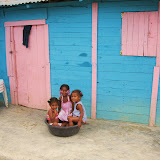
This semester I’m enrolled in a class that engages a community in the Dominican Republic; and traveling to the community is a requirement for the class, once in January, once in March. This community is an informal settlement (i.e. slum) called "Los Platanitos" in the outskirts of Santo Domingo, the capital of the Dominican Republic. Though this "slum" has been around for almost two decades, there are still no basic services, such as water and sewer. Electricity is intermittent. Furthermore, there is no trash pickup, which is the focus of our class (i.e. "solid waste management").

Los Platanitos is built in a narrow canyon that was formerly a landfill, so the people are literally living in not only their trash, but trash from decades ago. This problem is exacerbated when it rains because the trash impedes the flow of water causing frequent flooding. As I mentioned, there’s no sewer system, so flooding is a serious problem, yet the people have nowhere else to go. I could go on and on about the few good things and the many bad things about the place, but basically the people are lovely and the place is a mess.

Our class spent two weeks working in Los Platanitos, doing surveys of and interviews with the community; then a week meeting and working with local and national government and NGO officials. Our goal is to eventually apply for grants that might provide "seed" money for some kind of grassroots, community-based trash pickup. In summary, everyone there knows there is a trash problem, but we're the first ones to quantify it in hopes that something might get done.

While we were there we had a bit of a reality check on January 12th, as we felt the earthquake in Haiti. We had just returned to our hotel and as I entered my room I asked my roommate, "am I drunk or is this building moving?" (Needless to say, I wasn’t drinking). This was a "reality check" because as we were trying to help 500 people with their "trash problem" some 100,000 people died less than 150 miles away. It took some soul searching to find the nerve to say what we were doing “mattered” anymore.

The crazy thing is I happened to be in Port-au-Prince the week before. And, as everyone now knows, Haiti was in a bad situation before the earthquake. I could not help but continually compare Haiti to struggling sub-Saharan African countries. The people, the language, the poverty ... the corruption … I could have been in Zimbabwe, I felt.

I was only there a few days, so I can and can hardly say I “know” Haiti, but I left Haiti bewildered and distraught. Haitians were already in the most desperate situation: stuck on this little 1/3 of an island with no resources, no infrastructure, no opportunities. But they have a beautiful country, with beautiful and prideful people who are still hopeful. Riding a bus to the Dominican Republic, I distinctly remember thinking to myself "all this country needs is some good news."

I have been amazed by the tremendous response the world has made to help Haiti recover from the earthquake. I hope this goodwill endures a full recovery, because the Haitian people were already desperate something good to happen, even if just a headline. But even that was too much to ask.

un abrazote,
George


HAITI
Photos of Haiti
Video of Street in Petion-ville, Hiati
What's left of the home/orphanage I stayed at (this was an amazing, 7-story home for orphans and "restaveks" aka child slaves)
(Once again, I regret not taking more pictures)

DOMINICAN REPUBLIC
Photos of Dominican Republic
Boy walking barefoot
Video of Cañada (1)
Video of Cañada (2)

Saturday, January 30, 2010

Domincan Republic

Dominican Repbulic

(Same as Haiti post)

This semester I’m enrolled in a class that engages a community in the Dominican Republic; and traveling to the community is a requirement for the class, once in January, once in March. This community is an informal settlement (i.e. slum) called "Los Platanitos" in the outskirts of Santo Domingo, the capital of the Dominican Republic. Though this "slum" has been around for almost two decades, there are still no basic services, such as water and sewer. Electricity is intermittent. Furthermore, there is no trash pickup, which is the focus of our class (i.e. "solid waste management").

Los Platanitos is built in a narrow canyon that was formerly a landfill, so the people are literally living in not only their trash, but trash from decades ago. This problem is exacerbated when it rains because the trash impedes the flow of water causing frequent flooding. As I mentioned, there’s no sewer system, so flooding is a serious problem, yet the people have nowhere else to go. I could go on and on about the few good things and the many bad things about the place, but basically the people are lovely and the place is a mess.

Our class spent two weeks working in Los Platanitos, doing surveys of and interviews with the community; then a week meeting and working with local and national government and NGO officials. Our goal is to eventually apply for grants that might provide "seed" money for some kind of grassroots, community-based trash pickup. In summary, everyone there knows there is a trash problem, but we're the first ones to quantify it in hopes that something might get done.

While we were there we had a bit of a reality check on January 12th, as we felt the earthquake in Haiti. We had just returned to our hotel and as I entered my room I asked my roommate, "am I drunk or is this building moving?" (Needless to say, I wasn’t drinking). This was a "reality check" because as we were trying to help 500 people with their "trash problem" some 100,000 people died less than 150 miles away. It took some soul searching to find the nerve to say what we were doing “mattered” anymore.

The crazy thing is I happened to be in Port-au-Prince the week before. And, as everyone now knows, Haiti was in a bad situation before the earthquake. I could not help but continually compare Haiti to struggling sub-Saharan African countries. The people, the language, the poverty ... the corruption … I could have been in Zimbabwe, I felt.

I was only there a few days, so I can and can hardly say I “know” Haiti, but I left Haiti bewildered and distraught. Haitians were already in the most desperate situation: stuck on this little 1/3 of an island with no resources, no infrastructure, no opportunities. But they have a beautiful country, with beautiful and prideful people who are still hopeful. Riding a bus to the Dominican Republic, I distinctly remember thinking to myself "all this country needs is some good news."

I have been amazed by the tremendous response the world has made to help Haiti recover from the earthquake. I hope this goodwill endures a full recovery, because the Haitian people were already desperate something good to happen, even if just a headline. But even that was too much to ask.

un abrazote,
George


HAITI
What's left of the home/orphanage I stayed at (this was an amazing, 7-story home for orphans and "restaveks" aka child slaves)
(Once again, I regret not taking more pictures)

DOMINICAN REPUBLIC